
“The building replaced the Kitec years ago.” If you hear that during a Toronto condo showing, ask one more question: “Can I see the completion record for this suite?” A condo corporation can organize a plumbing project, replace shared pipes and send an update to every owner. You still need to know whether the contractor entered the unit you want to buy, which pipes were replaced and who paid the bill.
Before your offer becomes firm, try to settle three questions. Does any Kitec remain in the suite or the building? Could you inherit a cost or a deadline after closing? Will your insurer cover the unit on terms you can accept? The answers usually come from different people. A plumber can identify the installation, the condo corporation holds the building records, and your lawyer can explain what those records mean for your purchase.
A condo with a documented Kitec replacement can be a reasonable purchase. The harder one to evaluate is a beautifully renovated suite where everyone remembers the plumbing work a little differently.
What is Kitec plumbing?
Kitec is a plumbing system sold between 1995 and 2007. Its characteristic flexible pipe has an aluminum layer between layers of plastic and was commonly installed with brass fittings. Builders used it for hot and cold water supply and, in some properties, for hot-water heating. If a Toronto condo was built or extensively renovated during those years, ask about its plumbing history. The construction date alone cannot tell you which product the builder used.
The concern is premature failure. The Nova Scotia Real Estate Commission’s guide to Kitec plumbing explains how some brass fittings can lose zinc through corrosion, restricting water flow or weakening the connection. Failures have also been reported in the pipe itself. In a condo, a leak behind one bathroom wall can damage the suite below before the owner sees water on their own floor. A seller’s account of years without a leak is useful history, but it tells you little about the condition of concealed pipes.
Buyers sometimes worry that any reference to PEX in an inspection report means Kitec. PEX is a broader material description. If a report says only “PEX water supply,” ask the inspector what markings were visible, where they were found and whether the product could be identified. That distinction matters just as much for a seller who has already replaced Kitec with modern piping.
How to spot possible Kitec during a condo showing
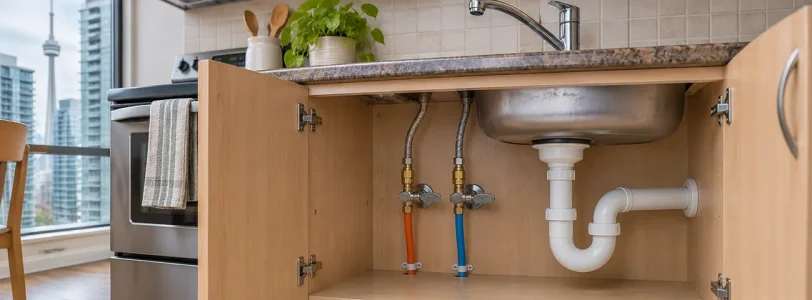
Look inside a bathroom vanity or under the kitchen sink, where the supply pipe emerges from the wall. Bright orange and blue piping can be a clue. Other products use similar colours, and Kitec was also sold in other colours. More useful clues include the name Kitec printed on the pipe, KTC stamped on a fitting, or product names such as PlumbBetter or IPEX AQUA. If the owner permits a photo, capture the full line of printing and enough of the surrounding cabinet to show where you found it.
Pay attention to which part of the plumbing you can see. The braided hose between a shutoff valve and a faucet tells you little about the supply pipe behind the wall. A new vanity can hide the connection altogether. A plumber might identify an exposed section under the kitchen sink with confidence while being unable to see the lines serving the shower, laundry or second bathroom. Ask for that distinction in writing. “No Kitec visible in accessible areas” leaves you with a different question than a report confirming which lines a contractor removed.
This is also a good time to ask what prompted a renovation. If the seller replaced a bathroom after a leak, ask for the repair invoice and any restoration records. If it was a cosmetic renovation, ask whether the contractor’s scope included supply piping. Either answer tells you more than the age of the tiles.
What proves Kitec was replaced?
The strongest record identifies the suite, the work and the completion date. It might be a detailed contractor invoice, a signed completion letter, or an entry for the unit in the corporation’s project records accompanied by the contractor’s scope of work. Several documents can establish the answer together.
| Document the seller provides | What to look for | What to ask next |
|---|---|---|
| Contractor’s invoice | Unit number, completion date and lines replaced | Does the description cover every affected room? Is there a more detailed scope? |
| Property manager’s letter | Confirmation that the contractor completed work in this suite | Were any lines excluded or any deficiencies left open? |
| Building-wide completion notice | The phase, tower or group of units covered | Is there a suite list or individual sign-off? |
| Renovation invoice or permit record | The work described and any recorded inspection or completion | Did the job include the concealed supply lines? |
| Photos taken before the walls were closed | Identifiable rooms and visible replacement work | Can the contractor connect the photos to the address, date and written scope? |
Read the description as carefully as the dollar amount. An estimate describes work someone proposed. A deposit receipt shows someone paid to get started. An invoice for “plumbing repairs” could cover anything from changing a valve to replacing every supply line. If the invoice is vague, ask the seller to authorize the original contractor to confirm what the crew did. A short email identifying the lines replaced can be more valuable than a folder full of kitchen renovation receipts.
Check the address, too. A development marketed under one name may have separate records for different towers, entrances or phases. A completion notice for the neighbouring entrance can look convincing until you compare it with the legal description in the purchase documents. If the seller gives you a newsletter addressed to all residents, ask management to match the project record to the unit you are buying.
What to look for in the status certificate
Give your lawyer the current status certificate package and flag the Kitec question when you send it. The Condominium Authority of Ontario’s explanation of status certificates identifies several items relevant to a plumbing project, including the corporation’s governing documents, budget, reserve fund information, insurance certificate and details of certain special assessments. Together, they give your lawyer a starting point for checking what the corporation has reported and what financial obligations deserve a closer look.
If you search the package for “Kitec” and find nothing, ask management how the project appears in its records. A notice might refer to domestic water piping replacement, an in-suite repiping program or a riser project. Those descriptions can refer to different parts of the plumbing. A riser carries water between levels, while a project inside a suite may cover the lines running from the unit shutoff to individual fixtures. Ask for the scope behind the title.
If the documents mention proposed or active work, focus on four details:
- Approval. Has the board obtained an estimate, awarded a contract or instructed owners to complete the work?
- Scope. Does the project cover shared piping, individual suites or both?
- Payment. Has an amount been allocated to this unit? Is there an outstanding balance or another instalment due?
- Timing. Has management issued an update since the date of the certificate that affects the period around closing?
An engineer’s recommendation with no approved budget leaves your eventual cost uncertain. An approved project with a dated invoice may give you a figure you can negotiate. A completed project with an unpaid balance raises a closing question even if the plumbing is already in good order.
Who pays for Kitec replacement in a Toronto condo?
Start with the corporation’s declaration and the documents for the particular project. Ask your lawyer to identify the relevant unit boundary and explain how repair responsibilities and costs have been allocated. The location of a pipe behind your bathroom wall does not, by itself, settle who must pay to replace it. The name of the person who hired the contractor does not settle that question either.
A Toronto court case illustrates the distinction. In Toronto Standard Condominium Corporation No. 1724 v. Eydassin, the corporation coordinated the engineers and contractors, while owners were responsible for the cost of replacing the Kitec pipes in their units. A seller in that building could accurately say, “The condo handled it.” A buyer would still want to see evidence that the suite’s bill had been paid.
The same distinction matters when you ask about special assessments. A corporation may levy a special assessment to cover a budget shortfall. An owner may also receive a separate bill for work in their suite. If management says there is no Kitec special assessment, follow up with a more precise question: “Has this owner been invoiced separately, or will I need to arrange or pay for any in-suite work after closing?”
Can you insure a condo that has Kitec?
Ask an insurance broker or insurer about the specific address, suite and remaining plumbing before your offer becomes firm. Insurers can take different positions on Kitec. An insurer may require replacement, impose conditions or decline to offer coverage. An online quote based on the postal code, square footage and purchase price leaves the plumbing question unanswered.
Give the insurer the information you can support. “The seller replaced the pipes” is difficult for an underwriter to evaluate. “Management confirms that the Kitec supply lines in this suite were replaced in 2021, and a second phase of shared piping work is pending” gives them a useful starting point. Send the supporting letter and request written confirmation of any conditions, exclusions, deductibles or replacement deadlines that would apply.
Share the corporation’s insurance certificate with your broker as well. Ask how your proposed unit-owner policy would respond to water damage, damage to improvements in your suite and any corporation deductible that could be charged back to you. If you need a mortgage, raise unusual insurance terms with your lender or mortgage broker before waiving financing. A replacement deadline is worth little if the corporation cannot give your contractor access in time to meet it.
How should Kitec affect your offer?
A known bill can be reflected in a purchase price or a written payment agreement. Missing approval to carry out the work is harder to resolve. A discount alone cannot give a contractor access, move a building-wide shutdown date or secure insurance coverage for closing day. How you structure the offer depends on which of those issues remains open.
If the replacement is complete
Match the suite number on the completion record to the purchase documents. Check that the record covers the affected piping and ask whether any balance remains. If the insurer accepts the documentation and management reports no outstanding work affecting the unit, evaluate the condo alongside comparable sales on its other merits. An old reference to Kitec in board correspondence may simply document a problem the owners have already addressed.
Keep copies of the scope, invoice and suite sign-off with your purchase documents. When you sell, the property manager may have changed and the original contractor may be harder to reach. Being able to pass those records to the next buyer can save both parties from repeating the investigation.
If replacement is scheduled
Request the work order, payment schedule and expected access dates. Have your lawyer address who pays any outstanding amount and what happens if the project runs past closing. A seller’s promise to cover “the Kitec cost” can leave room for disagreement if the plumbing invoice arrives before closing and a separate restoration bill arrives afterwards.
Consider how you will use the suite immediately after possession. A buyer who can leave it empty for several weeks may accept a schedule that would be difficult for someone moving in with children or starting a tenancy. If your offer assumes the work will be finished before closing, agree on what evidence will establish completion and what happens if the contractor misses the date.
If nobody can confirm the scope
Ask your agent and lawyer about an offer condition that gives you time to obtain the missing records, arrange an appropriate inspection and confirm insurance. Identify the specific gap. If a plumber has already found Kitec in the laundry, a second general inspection may tell you little. Management’s written replacement requirements and a contractor’s quote might answer the questions holding up your decision.
If the seller cannot provide records and there is no opportunity to investigate, compare the condo with a similar unit where the plumbing history is documented. Consider how much cash you would have after closing, how soon the work could happen and what coverage you could obtain in the meantime. If one of those questions has no workable answer, you have a concrete reason to reconsider the purchase.
Can a buyer still claim through the Kitec settlement?
The Kitec settlement claim form set January 9, 2020 as the filing deadline. A buyer discovering Kitec today cannot file a new claim through that settlement. If the seller says the corporation recovered money, ask management how the recovery was applied to the project and whether any balance remains for this unit. The figure that matters to your offer is the amount still payable.
Before you make the offer firm
Try putting your decision into one sentence: “I know which pipes remain, who must replace them, what I may have to pay and what my insurer has agreed to cover.” Wherever you have to substitute “I think” or “the seller was told,” you have identified the next question to ask.
Sometimes the answer is one missing page. A building notice says the project finished in June, and the contractor’s suite list confirms your unit was signed off in May. Sometimes that same page changes the purchase entirely: the previous owner deferred access, and the work is still outstanding. That is why a unit number beside a completion date deserves more weight than a general assurance that the building dealt with Kitec years ago.
If Kitec comes up in a Toronto condo you are considering, Ari Armani can help you request the suite and building records while there is still time for your lawyer, plumber and insurer to review them.